




March 13, 2013
About a week ago, on March 3, there was a fatal crash in Angel Fire. A Mooney M20E went down with 4 onboard. NTSB have already posted a preliminary report, with the following witness statement:
When the pilot arrived at the fixed base operator (FBO), an employee from the FBO questioned the pilot's intent to fly in the windy weather. The pilot indicated that he planned to fly and that the winds would not be a problem. When the pilot radioed on universal communications (UNICOM) that he was taxiing to runway 17, the current wind and altimeter were relayed to the pilot by the FBO employee, which were repeated by the pilot. Due to snow piles on the airfield, the FBO employee could not see the takeoff and next saw the airplane airborne with a significant crab angle into the wind, about 40 degrees right of the runway heading. The airplane rose and fell repeatedly as its wings rocked. Then employee saw the airplane's right wing rise rapidly. The airplane rolled left, and descended inverted with the airplane’s nose pointed straight down.
At 1315, an automated weather reporting facility located at KAXX, reported wind from 250 degrees at 33 knots gusting to 47 knots, visibility 10 miles, a clear sky, temperature 47 degrees Fahrenheit (F), dew point 17 F, and a barometric pressure of 29.93 inches of mercury.
Some people on forums speculated that a rotor caught him. But I think, it probably was a plain old stall in a gust. The rocking wings came from the laterial instability in a stall, not a rotor. I happened to fly an M20E, N5640Q, back when it was in the fleet of Alliance at FTG. Its useful load was 925 pounds. Suppose he had 20 gallons of gas. That leaves only 186 pounds per person, and the rear passengers weren't kids. I weigh 230 pounds. They probably had winter clothing for skiing, too. So, even if he wasn't illegal, I'm certain he was at gross and altitude performance of M20E was compromised. Departure to the south at Angel Fire puts one over a raising terrain (north has a hillcock too, although it's lower). These circumstances alone would tempt anyone into a departure stall, but he also faced crazy wind.
Most likely, the wind made the airplane too hard to control on the ground, considering the high snow banks, and he had to pop off prematurely to avoid putting a wingtip into one. But then, he didn't have the patience to accelerate in ground effect to a speed well in excess of Vy, which would give him the aileron authority to deal with gusts.
David White, the youngest commercial pilot in America, flies a more powerful version of the same airplane, an M20J. He boasted that he exceeded the demonstrated crosswind amount comfortably. It's possible that the pilot of N3484X did that before too, and that is why he was confident. However, the high altitude, full load, large gust factor, thick snow and raising terrain made this task that much more difficult.
Would I do better? Most assuredly. I would simply stay on the ground. The crashed Mooney wasn't the first airplane caught by Angel Fire's cross-wind, I know that much. It's unpleasant. I know of a case when N28GX was stuck in Angel Fire for 4 days before winds died down. But the risk is this great.
But also, there's a little local trick: do not depart to the south. The runway has a hump and the hump is way to the south. Eat the tailwind component, go downhill, then turn slightly right and just clear over the hillcock. Once you can see the lake, you're home free. Go over the lake to the east wall and the updraft will lift you clear out of the valley in no time. I did it once with my mountain instructor, Mr. Marc Coan. The required hugging of the wall may be too much for some and I would not dare do it on my own. But even so, just cut circuits over the lake until you're high enough. I did it once in the heat of summer in a Cherokee 140 that had almost no climbing capacity. That the hapless pilot of the Mooney went south tells me that he wasn't local, or he would've known not to do that.
P.S. I checked in A/FD and it says only 0.6% slope up rwy 17, which seems less than I recall. But still, go north even when it blows from 250, especially when you're at gross. The heavier the airplane is, the more advantage it derives from rolling downhill.
Posted by: Pete Zaitcev at
12:01 AM
| Comments (2)
| Add Comment
Post contains 779 words, total size 5 kb.
February 04, 2013
Insightful comment at Rand's place, in response to the sequestration, that almost makes a bold prediction:
[James] Hansen, the minority business outreach office, the education outreach group and the SLS will be the LAST things de-funded at NASA.
Government responds to cuts by trying to do maximum damage and holding things hostage. They cut police and fire on the streets before they fire deputy assistant directors. I would not put it past this administration to turn off the lights on the Mars Rover in a highly publicized show.
It must be noted that Obama administration tried to cancel SLS, and was overridden by porksters in Senate, so he probably means the national space administration.
Tags: space
Posted by: Pete Zaitcev at
04:45 PM
| Comments (1)
| Add Comment
Post contains 118 words, total size 1 kb.
February 02, 2013
Not being rich, I focused on the cheapest airplanes, such as Cessna 150, and was about settling into one of those, when the medical regulations struck in 2012. After getting the medical certificate back, I had to consider an SP-compatible airplane seriously. Unfortunately, factory made, they fall into 3 broad categories, neither of which I found terribly appealing.
Category 1 is a 1946 antique. When the short-lived aviation boom happened after the WWII, a great many personal airplanes were built, far more than the market could absorb. Many continue to fly, owning to the fact that the oppressive regulation was lagging the boom, and later they were grandfathered in. One can do a lot to keep an airplane flying, if the official documentation is limited to 1 sheet of paper describing the airframe limitations. Many of them sell below the price of Cessna 150, in cases going as low as $10k! Mind that I am only considering useable airplanes here, not corroded runouts.
Unfortunately, people of 1946 were small, very small. This is what made the personal airplanes of 1946 SP-eligible in the first place, but in the same time they barely function as 1-place airplanes today, and I find it difficult to fit into them. Performance of many of them is very disappointing, especially Chief. It may even be dangerous at the altitude where I live. Still, I found Luscombe 8A basically acceptable in the lot. But the deal-breaker is the need to maintain a true antique. I find it challenging, bordering on impossible. Every satisfied owner of such airplane has a hangar full of spare parts and tools, and spends a lot of time caring for the bird. I may afford the tools and spares, but I know that I'll never dedicate the time.
Category 2 is the modern LSA, built after the 2006 regulation change that created the LSA and SP as we know them today. They are invariably expensive. I looked closely at the leaders (CT and GX) at $140k, mid-runners like Allegro and Aerotrek for $90k, and the newest champ of the cheap, RANS S-6ELS, promised to reach $60k in 2013 dollars. I learned how the LSA industry does its utmost to make them cheaper. They even succeed, in a way, as the cheapest traditional airplane is $300k+ nowadays. But it is still too much.
Category 3 is the former "fat" ultralight. Some of them are S-LSA, most are homebuilts, very few are survivals of the 2006 devastation and grandfathered in as E-LSA. Kolb, Hawk, Gull. Now, the price of these is about right, in the teens, for the used ones (new S-LSAs hit about $35k+). But they are very much ultralights. The performance is nothing to write home about, neither in speed, nor in range. And no wonder, most fly with 2-stroke engines. These engines do not contribute to safety, either. Seisures, ignition failures, fuel supply failures -- all are common on them. Buying one of these means forgetting about any kind of travel by airplane, essentially.
So, what to do? My wife, ever the optimist, insisted that I stopped thinking about junk airplanes and endeavoured to keep the 3rd Class medical. But I thought of a better idea: if the industry won't supply me with an airplane, I can get a homebuilt!
Sadly, too many people had this great idea, and prices of decent RVs float in the vicinity of about $70k, give or take. And there's not much else that's worth looking at. Except Sonex.
Sonex is a product of well-regarded designer John Monett, who solicited it for a production in Europe, before offering it as a kit. It is easy to build, so I don't need to seek out examples built by experienced builders. It is an all-aluminum airplane, that makes it easy to maintain. Unlike most RVs, it is SP-compatible. And the performance of it is amazing: 135 KTAS is claimed by builders. We are talking Grumman AA-1B speeds here, but on 80 hp! Sonex accomplishes that in part by being very light (gross 1100 lbs), in part by using a lifting fuselage, that many people find butt-ugly, but I don't care. But above all, it's cheap. The 200-hour examples can sometimes be had for under $30k. Look at what kind of S-LSA is sold for $40k in Category 3 to feel the difference.
But it was not to be. Encouraged by these considerations, I seeked out a local builder, James in Los Alamos, who let me have a fit check. Results were disappointing, even prohibitive.

First, I cannot fit under the canopy. This problem is rather common for me in low-wings. The only S-LSA that I fit in is Evektor SportStar with the old pre-Harmony tall canopy, so there's nothing new here. In Sonex, I must crane my neck. James' airplane has the so-called "lowered seat mod", that comes standard on Waiex.
Some builders make the canopy bubble up a bit, but it gives up the speed and may be problematic in case of a crash, because the tail is still the same.

Second problem is control interference. It is less visible, but just as serious. It turned out that my thigh is jammed hard between the flap lever and the stick. Sonex Aircraft offers an option of moving most of controls to the center, which may help. But the airplane is just small no matter what.
So I had to back off for now. But a Sonex/Waiex/Xenos/Onex would be an awesome deal for someone who's short.
Posted by: Pete Zaitcev at
11:12 AM
| No Comments
| Add Comment
Post contains 926 words, total size 6 kb.
January 20, 2013
Just got back from Utah, went to have a quick look at an airplane I considered buying.

As usual, things took longer than anticipated, and I had to get in after sunset. The visibility was unlimited, sky clear, Moon in new half. And yet, for a Sport Pilot, the flight would be illegal. As a Private Pilot, I can do it. Frankly, this very much reminds me about the way things are priced for market segmentation. Except that FAA do not sell pilot licenses, so why do they segment them this way?
To be sure, the difference between an Airline Transport Pilot (or ATP) and lowly PP is enormous. It is big enough that it makes sense to make it a job selection criteria: you have to have a PhD in Physics to be considered for job X, haven ATP certificate for job Y, or MSCE for job Z (ha ha ha). Now, Commerical Pilot is not quite as good as ATP, but it's still better than PP. But the SP...?
The whole point of SP is that you can excercise your privileges without also acquiring a medical certificate. Fine. But how does it have anything with flying at night? It's not like the AME checked my night vision or vertigo resistance.
But wait, you say, SP is not trained to fly at night. Duh.
True. But this is completely circular reasoning. The SP is not trained to fly at night, because FAA said that they cannot fly at night, and so they are not tested, they do not log mandatory night hours, and so on. But that is because they cannot fly at night, so why have this on the license, and that is because... Well. Nothing of this has anything to do with the lack or medical certification. It's just that FAA intentionally castrated SP rules in order to create an incentive for people to get PP.
You know, I am starting to think that people who petition FAA to forsake all this stratification and simply drop the 3rd Class Medical may be right. It would make a complete sense. Of course, someone in CAMI building in OK City may lose a job if we allow for too much sense in government regulations, and that just will not do.
Posted by: Pete Zaitcev at
09:15 PM
| No Comments
| Add Comment
Post contains 386 words, total size 2 kb.
December 29, 2012
Paul Berotrelli of AVWeb posted his take on 2010 GA fatals (h/t GHW) that generally comes to this: stalls and LOC are the biggest killers, while pilots, allegedly, worry too much about things that do not actually kill them.
I think he's got a point, because when I came very close to a departure stall while on a night currency hop, it was remarkable for the ease of it. The airplane was even trimmed correctly.
So, what to do? Paul laments how electronic gadgets numb us to flying properly, and simultaneously suggests to install AoA indicators. It's not necesserily contradictory; the indicator may be a piece of string rubbing on side window. And even if electronic (like comes from the factory on Remos GX), it teaches the pilot what it is at various flight regimes. Just don't get into a habit of getting your eyes glued to it.
Posted by: Pete Zaitcev at
09:28 AM
| No Comments
| Add Comment
Post contains 155 words, total size 1 kb.
December 19, 2012
If one asks a new American pilot to name a front-engine motorglider, he would probably name Phoenix. If he's a Sport Pilot, for sure. But in the glider world, the most famous is probably G109. Grob is ubiquotus everywhere, with its G103 providing the backbone of commercial operations across the country. It's a big name. The G109 even has got a Wikipedia page, while Phoenis has not. Still, I learned about G109 because a guy in Japan flies a G109B and I ran across his blog.
Phoenix is slightly lighter than G109, and its engine is slightly more powerful. Grob apparently makes own engines (no, really!), and a 97 hp Porsche-based version is installed at G109B. G109 does not have removable wingtips, but it does have detacheable wings, common for traditional gliders. Obviously, it is not eligible for flying by Sport Pilots. Perhaps it plays a part in Grob being more than twice cheaper in the market.
Posted by: Pete Zaitcev at
05:15 PM
| No Comments
| Add Comment
Post contains 162 words, total size 1 kb.
December 07, 2012
To more more precise, he is discussing the process of buying EX-AB, or Experimental Amateur-Built, or "homebuilt" airplane. Several other categories of Experimental airplanes exist, such as EX Flight Test and EX Exhibitional. But those are of less relevance to most private aviators. Here's an executive summary (RTWT):
- "The current FAA interpretation allows you to do your own maintenance, but not the yearly inspection."
- "Be sure the go over the logbooks and other relevant paperwork for the aircraft. [...] It must have the operating limits as issued by the FAA – this is very important for an experimental category airplane."
- "The art of inspecting any airplane is best left to an expert and someone not emotionally attached to the purchase."
The two big reasons to buy experimentals are features and costs, together and separately. With the exception of LSAs, the state of art in private airplanes have long stagnated, while EX-AB evolved to the point that leading kit airplanes beat basic certificated airplanes by a very large margin.
If we look at Sonex, for example, then we have an airplane that simply has no equivalent factory airplane. It is lighter than LSA weight limits, which is almost unheard of. It is fast: about as fast as the best LSAs near the legal limit. Or about as fast as Piper Arrow is, which has a retractable landing gear and a 200 hp engine. And the best news is, you can buy a lightly used Sonex for $27k to $45k, and you can fix it yourself. The latter is extremely important, because costs of maintenance of certificated airplanes are quite high, and owners are legally prohibited from working on them. Sure, you can buy an Arrow for $45k, but you cannot maintain it for $1000 a year. On the LSA side, a CTLS will set you back by $135k.
Now, of course, if should be obvious that Arrow is a 4-seat airplane and Sonex is only good for taking a pretty girl for sightseeing. It is much, much smaller than Arrow. So, for some kind of mission, like carrying your family, Sonex is not suitable. But the point is that the other mission, flying solo cheaply, is not addressed by the factory built airplanes.
If Congress legislated that cars were only to be maintained by certified mechanics who have to take fairly expensive classes and pass strict exams, you may be looking at a significant increase in costs, too. Well, that, and a flourishing black market in fake certificates and outside-the-book repair.
Posted by: Pete Zaitcev at
06:08 PM
| No Comments
| Add Comment
Post contains 425 words, total size 3 kb.
December 05, 2012
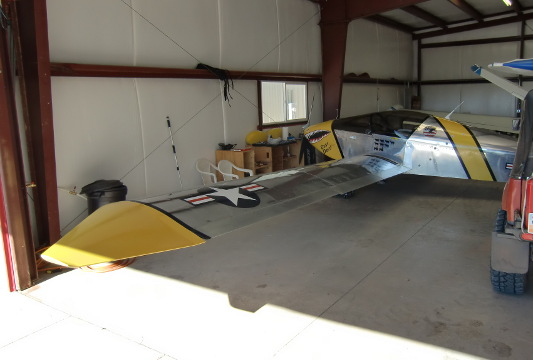
Design of Phoenix is not entirely unique. Sonex Aircraft, for example, offer a motorglider called "Xenos", essentially made out of taking basics of their eponymous Sonex airplane and adding a large span wing. Xenos even features removable wingtips, although they are nowhere as elaborate as those on Phoenix. Not only wingtips of Phoenix have proportionally larger span, but they also include aileron extensions.
The biggest difference between the two is perhaps not the construction methods and materials, or number of seats, but that Phoenix is a factory-built airplane, while Xenos is amateur-built. Sonex Acft only supply a kit and instructions how to register a motorglider with FAA. Also, marketing for Xenos does not make a big deal from the following observation:
The Xenos can either be flown as a Sport Pilot/LSA, or it can be flown by pilots that hold a glider rating with a self-launch glider endorsement.
UPDATE 2013/1/19: I had a chance to photograph Xenos and its high-aspect wing:
Posted by: Pete Zaitcev at
11:05 PM
| No Comments
| Add Comment
Post contains 165 words, total size 1 kb.
November 18, 2012
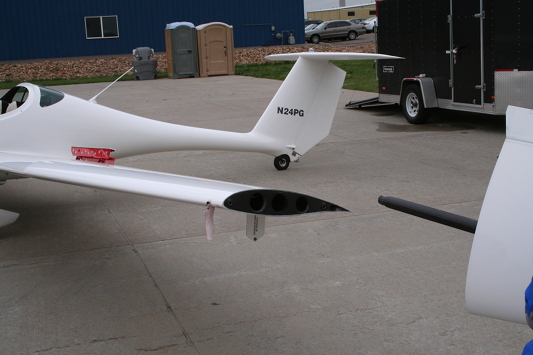
The usual Dan Johnson review of LSA sales of September 2012 is titled "Cessna tops LSA market list", but it contains an even more interesting tidbit than that:
One surprise is Phoenix, the sleek motorglider builder, whose U.S. importer registered four in 2012 but reports having sold 20. "We cannot keep up with orders from customers,†Jim Lee reports, "even though the production rate has increased.â€
What is Phoenix?
I saw one at 2011 Rocky Mountain LSA Expo. Jim Lee, the driving force between American adoption of Phoenix, flew his demo unit from his base in Florida. Not to put too fine point to it, it's an LSA-compliant low-wing motorglider with a side-by side seating.
So, what is the big deal?
The big deal is that Phoenix, being a glider, can be flown by a pilot with a denied medical certificate. But as Jim demonstrated, it's perfectly feasible to fly cross-countries in it. In other words, it's the final loophole in the regulations for people who were blindsided by the FAA.
In theory, the provision for letting the medical certificate expire should cover everyone. You track your health, and as you are getting older you know what you may not pass. Then you let the medical lapse and retain the Sport Pilot privileges. Simple, right? But in practice, it's trivial to get caught out. I am only 46, and I was.
What then? Only a glider. But a glider cannot get you anywhere... Unless it's a motor-glider!
Phoenix, however, is different from other motorgliders in that it's specifically designed to exploit the loophole. Because their engines only work for a short time, traditional motorgliders tend to have a puny fuel supply, and their engines are often inefficient and have a short lifespan. Many use 2-stroke or jet engines. Phoenix is powered by the good old Rotax 912ULS, used on many LSAs. It is economical and reliable enough for true cross-country flying.
But wait, there's more. Phoenix is also an LSA, and people are legal to fly it that way too. With only 20 hours you're good to go. But is it a good idea, especially since Phoenix is configured with a tailwheel? When I talked to Jim at the Expo, I received an impression that he was advocating reduced training. He said plainly that "one does not need a tailwheel endorsement to fly Phoenix, because it is a glider". That statement could be parsed in various ways. I was in touch with Jim since, and he explained it thus: "I would be very surprised if any gliderport in the world told a glider student to go get tailwheel training in an airplane first!" In other words, glider pilots have to deal with tricky directional control anyway. However, if you are an SP in a common LSA, it is my opinion that you need that training. It took me about 10 hours, which is not that big a deal. A 20-hour pilot may think differently, but I advise against skipping it.
The final feature of Phoenix that I would like to mention is that of its removable wingtips. The definition of a glider is a certain wingspan load (otherwise everyone would register their LSAs as gliders). I thought at first that it was a compliance trick. But Phoenix supposedly complies even with wingtips removed. The real advantage of having them is that Phoenix can be parked in a regular T-hangar.
All in all it's a remarkable airplane. Although I am far from the price bracket it is in, I am quite happy to see it finding buyers. Who knows, maybe one day I can pick one used.
Posted by: Pete Zaitcev at
10:32 AM
| No Comments
| Add Comment
Post contains 608 words, total size 4 kb.
November 14, 2012
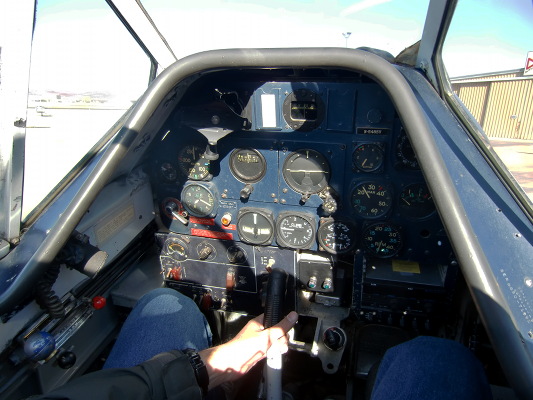
Today I put a 1.0 hobbs on Don Symington's 1945 North American SNJ out of Santa Fe (currently Warbird.US). We only made one landing and Don did it, of course. If Walter Eichhorn can screw it up, what are my chances? Although, Don said that he always makes 3-point landings, even touching tail first, in part because the minimal energy makes it so the airplane won't fly away from you. He said that people making wheel landings in T-6 "are asking for it". He still had to do the normal prompt rudder work after the touchdown, of course.
As of now this is officially the most powerful and fastest airplane I have flown, albeit not landed (previously the Mooney M20E was the fastest, and C-182 was the most powerful). But it was an amazing experience in other ways, too. John Lorenz's Interstate is somewhat older, being a 1942 model. This, however, is a genuine military airplane, or a "warbird", as they are known, in the same way BAE Hawk or Yak-130 are today.
In conclusion, I'm quite glad that I stopped procrastinating and took this flight. Who knows how much longer the warbird is going to be available.
UPDATE 2014/05/18: Ouch, ouch, ouch. That bent spar isn't going to be cheap to fix. However, I heard that Don and his passenger are allright.
Posted by: Pete Zaitcev at
10:05 PM
| No Comments
| Add Comment
Post contains 226 words, total size 1 kb.
Saddened to hear that Steven Den Beste suffered a stroke, fortunately a "small" one. He was clear enough to write an e-mail to Don. When my wife's brother had a stroke, he could not read or write: saw letters but they made no sense to him. That's how he found out: checked in at work, sat at his computer, and could not understand anything. On the other hand, he wasn't paralized, and apparently Steven has effects on motion. So it may be small but not great news anyway.
UPDATE 2012/11/23: He's in rehab.
Posted by: Pete Zaitcev at
09:32 PM
| Comments (2)
| Add Comment
Post contains 97 words, total size 1 kb.
October 28, 2012

Brent, a new blogger on the block and a CFI, started a series on flying a taildragger. His post reminded me about something: I have no butt sense.
Yes, really. Although I have a vestibular apparatus working well enough to skate, I could never detect any signals from my butt, however slight. I knew about it long before I became tailwheel qualified, which I did purely by signt. In flight I have to rely on the ball, or in case of a glider, string. Many pilots assume that the butt sense is something that everyone can develop, as seen from Brent's quote:
The sight picture you build coupled with your seat of the pants sense of swerving, help in early detection so you can make small corrections. // Beginning students don’t have these skills so it takes practice and coaching to build up the muscle memory, sight picture, and to trust you butt.
Well, yeah. I actually took a specific effort to look into the butt issue a couple times, because mastering it would be extremely handy to exclude the ball from scan. I found that I can detect the sideways force by sensing the tug on my upper body before the butt reports anything. Unfortunately, even that occurs at far too great an angle to be useful (e.g. by the time I recognize the laterial force, I risk a spin).
In practice, if I am well familiar with the airplane, I just dial the rudder input that I know is about right for the maneuver, and drop a quick glance at the ball to verify that I hit it. Still, as I read the reference after referece at someone's sensitive butt, I get envious. Yes, I am envious of Brett's butt — in a manly way.
UPDATE: 201: wheelies.
Posted by: Pete Zaitcev at
07:58 PM
| Comments (1)
| Add Comment
Post contains 303 words, total size 2 kb.
October 14, 2012
For some reason, even the most menacing thunderstorms look mundane on camera:

Yeah.
This lens flare effect is not a post-processing filter:

Does not happen often to me, perhaps even for the first time. Pictured, of course, is "FiFi", the only B-29 still flying.
Sorry for being shallow, but it's too funny. This pilot is about to commit an embarrassing mistake:

Can you spot it?
Well, I once forgot my airplane keys in the bag, and only found about it when we strapped in, so...
Posted by: Pete Zaitcev at
06:25 PM
| No Comments
| Add Comment
Post contains 88 words, total size 1 kb.
September 04, 2012
For this year's showing of anime to rednecks, I wanted to expand it a little. Usually they are not in any way interested, and last year I had basically make them watch Cat Shit One at gunpoint. They liked it, however. So, it naturally came to re-watching it, this time on R1 DVD.

Cat Shit One: Bunnies killing the living shit out of everything.
But I wanted to add a little something, the question was what. It had to be available to me away from the Internet (Crunchyroll.com suddenly became a big problem). It had to be sufficiently outrageous or epic, too. And it had to be accessible to the uninitiated. I thought about, for example, post-timeskip Gurren-Lagann, which is the most epic of them all. Remember how Lord Genome said: "I know I have no right to act as your father, but you've done well"? And Nia replied: "Thank you, father"? And then they went total badass. I get chills just recalling that. However, it's a Super Robot show, and it's 20+ episodes of build-up before that. So, I put kibosh on that, and a few other worthy candidates.

Midori no Hibi: She is more than his right hand.
Eventually it came down to an episode of each of Midori no Hibi and Strike Witches. The former, I think, showcases the good side of anime well, and is pretty funny. The later is quite outrageous enough, and I have it on legal DTO that I bought from BOST.com.
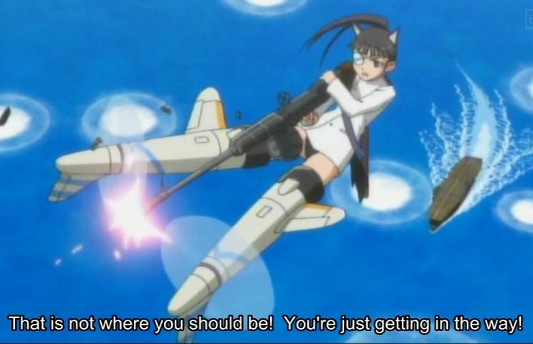
Strike Witches: Pants would only get in the way.
In the end, the showing was a modest success, and hopefuly set some expectations better. Already thinking about the next year, and yes, if it means go pirate, so be it.
Tags: anime
Posted by: Pete Zaitcev at
06:11 PM
| Comments (1)
| Add Comment
Post contains 295 words, total size 2 kb.
August 28, 2012

Look what we've got here: a classic ultralight from 1980s! Sadly, the ultralights collapsed with the introduction of Light-Sport regulations by FAA in 2006, when our government decimated the ranks of ultralight instructors. Now it is next to impossible to learn to fly in an ultralight (it is illegal). So, ultralight flying is now the province of retirees who lost their medicals and a few daredevils who teach themselves to fly. It's a great pity, IMHO, and a great example of government's power to destroy.
Posted by: Pete Zaitcev at
07:42 AM
| No Comments
| Add Comment
Post contains 88 words, total size 1 kb.
August 17, 2012

I thought about keeping it quiet until I got my endorsement, but what the heck: I'm learning how to fly an airplane with "conventional landing gear", or taildragger. Pictured above is yours truly at controls of a 1942 Interstate S1A Cadet. Soon I may be able to fly a Phoenix (post is coming up).
Aside from that I experienced an amazing phenomena today. Imagine an air mass, sitting there peacefuly. Then, a few miles away, another air mass, only this one moves at fairly brisk rate, perhaps 30 knots. What do you think the interface between the two is? I imagined it would be a bunch of air eddies and separated currents, kind of like sides of Gulfstream. But in fact, the boundary layer is very thin, and not that turbulent. The two air masses slide with little friction, like two blocks of wood.
Before the flight, I looked at the satellite loop, and the border between the stationary air and the moving air expanded across the whole state. Of course, I could only see the motion of clouds, so I put it down for some kind of weird uppper level jet stream. But in the event the two were going all the way to the surface.
An airplane penetrating the boundary experiences a few slight jolts, but then starts flying sideways (or straightens out, depending). It's quite amazing.
Of course, I knew about the rotating air currents, such as Wood's vortices, dust devils, and the like. They exhibit a well-defined boundary, too. But this is entirely unlike a nuclear mushroom, or a frontal system (the boundary of which is very thick).
Posted by: Pete Zaitcev at
08:11 PM
| No Comments
| Add Comment
Post contains 277 words, total size 2 kb.
August 14, 2012
Brian Binnie is most known to me as a controversial figure after the crashed SpaceShipOne. I heard that Mike Mellville raised his voice at a meeting and suggested that Brian just did not have the right stuff, and so "flew into runway", and that he would show Brian how it's done. And he did! IIRC, Brian did not fly SS1 afterwards, while Mike was throwing M&Ms around the weightless cockpit. Months and years passed. Brian published a weird article in Salon or Smithsonian, I do not remember well, where he tried to come to grips with that accident. It was painful to read. I thought we would not hear of him again, but -- surprise -- he was promoted to a managerial role at Scaled. He became a director of flight ops. I thought it was pretty good for everyone involved: Brian gets a raise and stays out of cockpit.
Well, maybe not. A report at Clark Lindsey's new digs mentions that Brian was a co-pilot at the 11th SpaceShipTwo test.
To be sure, even if Brian was inferior to Mr. Mellville as a pilot, he's still a thousand times better than I am. Also, SS2 was specifically designed so that any good airline captain could fly it, unlike SS1. Remember that SS1 had no air brakes and the only way to aim it for touchdown was to vary the radius of gliding circle! So he's not going to kill any revenue passengers. But man, what a cool job, and nobody is there to tell you no (I think Mike retired before Burt).
Tags: space
Posted by: Pete Zaitcev at
09:54 AM
| Comments (1)
| Add Comment
Post contains 270 words, total size 2 kb.
August 06, 2012

I do not recall ever seeing a hand washer for sale in America. This one is an import from Russia.
Posted by: Pete Zaitcev at
10:19 AM
| Comments (2)
| Add Comment
Post contains 23 words, total size 1 kb.
August 05, 2012
In a post at Air Facts by John Zimmerman relates a scud run (in a helo) mostly focusing on "lessons", while only mentioning rules thus:
There are some rules that simply must be obeyed, like having a hard limit on how low you will fly and never getting backed into a corner.
Wouldn't it be useful to list all rules though? Peter Garrison undertook just that a while ago (in the Flying magazine):
There are some simple rules to remember about scud running. Don't do it at night. Don't fly toward deteriorating weather -- by the time you decide to turn around, it may have shut down behind you. Don't follow the bright spots -- "sucker holes" -- but hold a heading and follow landmarks instead. Don't fly under a ragged, foggy overcast; stick to nice crisp ones with clear air underneath. If you're down so low that you can read the Surgeon General's warning on the billboards, give up and land.
Note that Peter's rules are somewhat self-contradictory: if you fly a heading, you cannot stick to crisper overcast. In other words, judgement is required when applying them. Still, they are somewhat comprehensive rules that are more useful than John's hard-limit rule.
Since we're on the topic, my last experiece of scud running occured when I and Chuck departed RM LSA Expo in FTG. The difficulty was that while the weather was acceptable for a VFR departure, we had to cross a higher ground between Denver and Colorado Springs. I cannot call it a "ridge". But it was enough of elevation to make things interesting indeed by pushing us into clouds from below.
I was the Pilot in Command for the leg and I'm sure I made Chuck uncomfortable with some of the decisions. He wanted to wander to bright spots, but, armed with Peter's wisdom, I declined his suggestions, and stuck to the heading as much as possible. At one point I identified a large hole because I saw a tower inside that projected on the cloud wall on the other side. Chuck was unable to see the tower, which is unsurprising, considering that he's in his 70s. For balance, he has about 40 times as much flight experience than I: well north of 6000 hours. I had to think very hard if I wanted to disregard his advice.
But other than the need to consider if we were likely to get cut off, that flight was largely stress-free, quite unlike the time I flew between snow squalls near Mountainair. In the worst case, Chuck and I would be illegal for a few minutes while beating retreat to Front Range. But back then, I had to worry if defroster was able to handle the blowing snow, and what would happen if Aspen packed it in. Unfortunately, Peter's rules do not account for the large difference in weather severity. Maybe I should add Pete's Rule to them.
Posted by: Pete Zaitcev at
04:27 PM
| No Comments
| Add Comment
Post contains 493 words, total size 3 kb.
July 26, 2012
Oshkosh, as usual, produced a flurry of announcements, including those about diesels. It happens each year, and always bloggers run with headlines like Diesel emerging as new technology of choice for general aviation", this year on top of a single announcement (although later, Janice posted an announcement of Continental diesel). Two points about that.
#1 is the insane costs. Cessna's 182-with-SMA aka "NXT" is listed for more than half a million bucks as a start.
#2 is the dog that did not bark: Deltahawk. In my opinion, their architecture offers great advantages over the traditional car-style diesel that SMA offer. They have a booth. They are working on certification... for a while now. And yet, no announcements this year.
Posted by: Pete Zaitcev at
08:06 PM
| No Comments
| Add Comment
Post contains 123 words, total size 1 kb.
32 queries taking 0.0619 seconds, 76 records returned.
Powered by Minx 1.1.6c-pink.